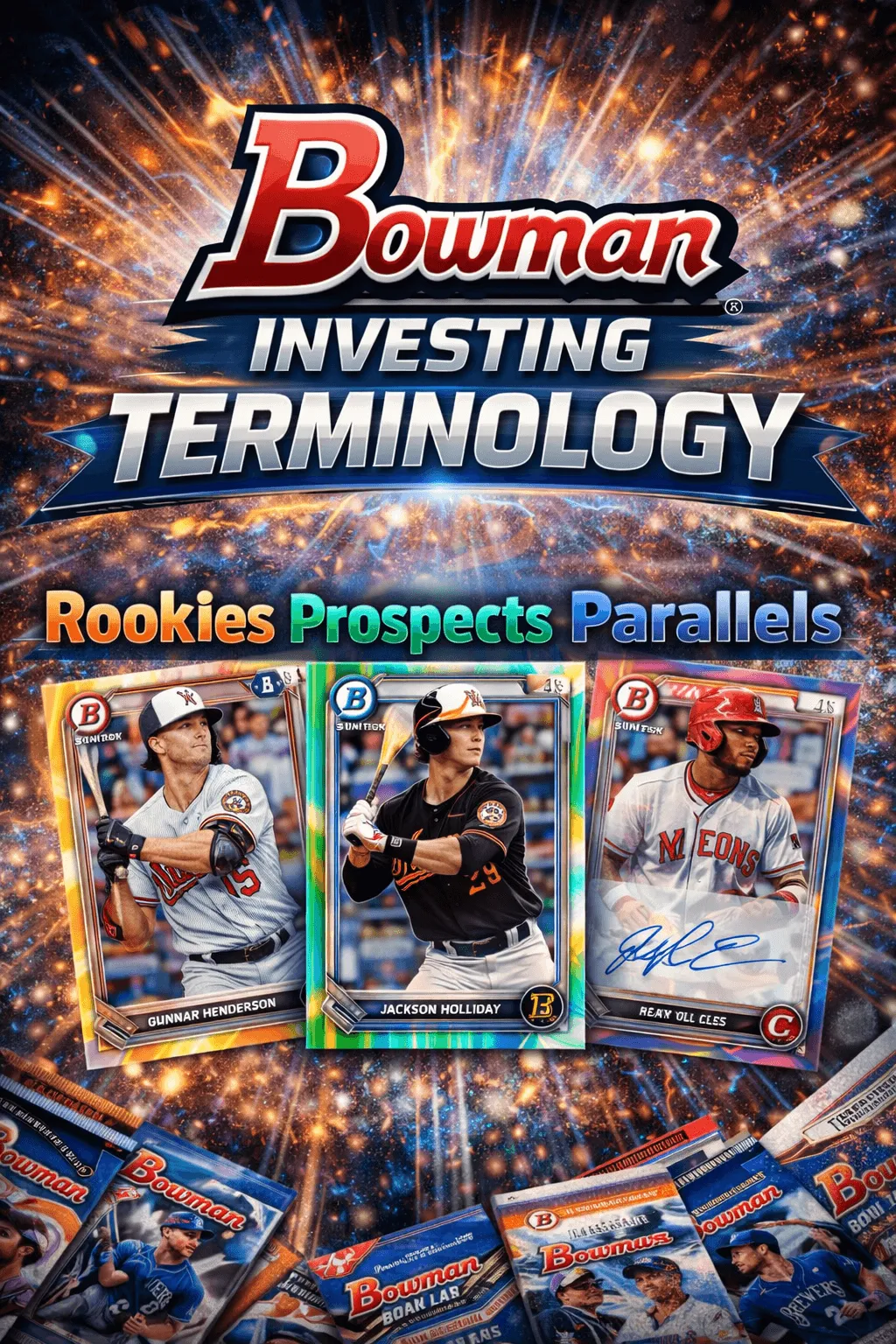
Bowman Investing Terminology
Once you understand the different Bowman releases, the next component to tackle is how to wisely invest dependent on your bankroll. All the different inserts, numbered parallels, autographs, paper vs chrome, mega box, image variations, 1st Bowman, etc. within the product can be very overwhelming. Buying without the knowledge can cause you to lose a good bit of money. Which cards are the most desirable, which ones can you flip for easy profits, and which ones don’t bring much hobby value? There are many ways to make money with Bowman investing, and there are several different price points for profit. Knowing WHAT to invest in, knowing WHO to invest in, and knowing WHEN to invest and sell are all key components for making a profit.
In this article, we will focus on the WHAT to invest in. It might be easier to digest if we define the different cards within Bowman products:
Paper: Bowman and Bowman Draft contain “paper” versions of each card. You can easily recognize these by the “B” in one of the upper corners on the front of the card. If it is RED, it is a “paper” version of the card. You can also identify “paper” versions of the card by the number on the back of the card. “Paper” versions of a card will not have a “C” (for chrome) designed in the number. For example, a card in Bowman Draft will have a version numbered BD-1 (paper version), and the same card also numbered BDC-1 (chrome version). The Bowman Chrome release in the later summer is the only product that does not include “paper” versions of the card. Paper cards are worth less than their chrome counterparts, but you can still make profit on paper cards, especially of top prospects. Another way to profit on chrome cards is to take the “paper spot” in breaks. You can then sell players in parge paper lots. We will go over this more later in a breaking article.
Chrome: Chrome versions of a card can be identified by a BLUE “B” in one of the upper corners on the front of the card. Chrome cards also have a glossy chrome finish on the front of the card. As stated in the “paper” section, chrome cards will be numbered with a “C” (BDC-1 vs BD-1 for the same card). Chrome cards are worth more than their paper counterparts; however, chrome cards are often harder to find in gem mint condition due to the imperfections (scratches, print lines, dents, dimples, etc.) on the surface. We will go over this more in a future grading article.
1st Bowman: This is probably the most important designation on a Bowman card in terms of value. A player can have a Bowman card in 20 different releases, but they will only have ONE “1st Bowman.” As you can probably guess, a player’s card will be designated with a 1st Bowman logo in one of the upper front corners of the card when it is the FIRST Bowman card that player has ever had. If a player has his 1st Bowman card in 2025 Bowman, his cards in 2025 Bowman Chrome and/or 2025 Bowman Draft will not have that 1st Bowman logo. The 1st Bowman logo increases a card’s value by a lot.
Autographs: I know it is obvious what an autograph is, but there are several things that determine which autographs are more valuable than others. The most valuable autograph will be the one designated with the “1st Bowman” logo.
Some players will have their 1st Bowman cards as an “auto only”, meaning they will not have a non-auto version of their 1st Bowman card in that release (i.e. Juan Soto in 2016 Bowman Chrome only has an autographed card).
Conversely, a player can have a 1st Bowman card in a release but not have a 1st Bowman autographed card in that release (i.e. Jackson Merrill in 2021 Bowman Draft).
Every now and again you will see a player have a 1st Bowman card in a release, not have a 1st Bowman autograph in that release, but then have an autograph in a subsequent release which is designated with the 1st Bowman logo (i.e. Jackson Chourio’s 1st Bowman non-auto is in 2022 Bowman; however, his 1st Bowman auto is in 2022 Bowman Chrome).
Players who don’t have a 1st Bowman logo on their first autographed card in a Bowman product (Jackson Merrill, Brady House, Sebastian Walcott, etc) will see the values of those autographed cards come in much lower than similarly ranked prospects who have 1st Bowman autos.
A player can also have an image variation card in the same release as their 1st Bowman card. If the image variation card is an autograph after 2019, it will not have a 1st Bowman logo. I believe Wander Franco in 2019 Bowman is the last player to have an image variation auto with the 1st Bowman logo as well as having a regular 1st Bowman autograph in the same product. Even though image variation autographs are often rarer, they will still not carry as much value as an autograph with the 1st Bowman logo.
One thing to be aware of is “in-person” autographs. This is when an individual has the player sign any card that was produced by Topps without an autograph. These autographs are not certified by Topps and do not carry as much value. Topps certified autographed cards will have a white rectangle on the front of the card designated for the player to sign, and the card will be numbered on the back with an “A” and some variation of the players initials (i.e. CPA-CC for a 2025 Bowman Charlie Condon auto).
Inserts: Inserts are different sub-sets within a product. Some are rarer than others, some have numbered parallels, and some are just base inserts. As time passes, inserts are usually not as valuable as non-inserts.
Numbered Parallels: A particular card will come in different colors with different numbers of that card produced for each parallel. For instance, there may be a Bowman chrome autograph of a card (known as a “base auto”), and that same autographed card will have an orange colored parallel which only has 25 produced (numbered out of 25 on the card; designated as x/25). We will take a deep dive into these numbered parallels in a future article.